When Elizabeth came to the throne, England was Catholic. Mary I (Bloody Mary) had reversed the religious changes of Henry VIII and Edward VI (the Reformation) and restored the authority of the Pope.
Elizabeth was determined to make England Protestant again. She had been brought up a Protestant and furthermore, in the eyes of many Catholics she was illegitimate because the Catholic Church did not recognise the marriage of her parents. However, Elizabeth did not want to divide her country. She therefore decided that her religious settlement would be a via media (middle way) - a Protestant Church, but with as little as possible to upset Catholics. She hoped that everyone would be able to accept her Religious Settlement which was passed by Parliament in the Act of Uniformity and the Act of Supremacy in 1559.
To please Protestants:
The Pope was no longer in charge of the Church.
The Bible and Church services were in English.
Priests could marry.
Altars were replaced with simpler communion tables.
To reassure Catholics:
The Queen would be the 'Supreme Governor' of the Church (not the Head).
Priests continued to wear vestments.
The Prayer Book was written in an ambiguous way so Catholics could interpret it in their own way.
Recusancy fines, for not attending church, were kept low.
Elizabeth encouraged Church decoration and Church music.
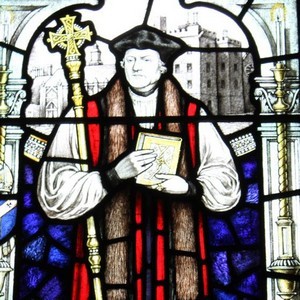
Archbishop Matthew Parker (window in Chester Cathedral)
When Elizabeth came to the throne, England was Catholic. Mary I (Bloody Mary) had reversed the religious changes of Henry VIII and Edward VI (the Reformation) and restored the authority of the Pope.
Elizabeth was determined to make England Protestant again, but did not want to divide her country. She therefore decided that her religious settlement would be a middle way - a Protestant Church, but with as little as possible to upset Catholics.
When Elizabeth came to the throne, England was Catholic. Mary I (Bloody Mary) had reversed the religious changes of Henry VIII and Edward VI (the Reformation) and restored the authority of the Pope.
Elizabeth was determined to make England Protestant again, but did not want to divide her country. She therefore decided that her religious settlement would be a middle way - a Protestant Church, but with as little as possible to upset Catholics. She hoped that everyone would be able to accept her Religious Settlement.
To please Protestants:
The Pope was no longer in charge of the Church.
The Bible and Church services were in English.
Priests could marry.
Altars were replaced with simpler communion tables.
To reassure Catholics:
The Queen would be the 'Supreme Governor' of the Church (not the Head).
Priests continued to wear vestments.
The Prayer Book was written in an ambiguous way so Catholics could interpret it in their own way.
Recusancy fines, for not attending church, were kept low.
When Elizabeth came to the throne, England was Catholic. Mary I (Bloody Mary) had reversed the religious changes of Henry VIII and Edward VI (the Reformation) and restored the authority of the Pope.
Elizabeth was determined to make England Protestant again. She had been brought up a Protestant and furthermore, in the eyes of many Catholics she was illegitimate because the Catholic Church did not recognise the marriage of her parents. However, Elizabeth did not want to divide her country. She therefore decided that her religious settlement would be a via media (middle way) - a Protestant Church, but with as little as possible to upset Catholics. She hoped that everyone would be able to accept her Religious Settlement which was passed by Parliament in the Act of Uniformity and the Act of Supremacy in 1559.
To please Protestants:
The Pope was no longer in charge of the Church.
The Bible and Church services were in English.
Priests could marry.
Altars were replaced with simpler communion tables.
To reassure Catholics:
The Queen would be the 'Supreme Governor' of the Church (not the Head).
Priests continued to wear vestments.
The Prayer Book was written in an ambiguous way so Catholics could interpret it in their own way.
Recusancy fines, for not attending church, were kept low.
Elizabeth encouraged Church decoration and Church music.