1588 |
Court |
Elizabethan Life |
Religion |
Historic Environment |



0
1588 |
Court |
Elizabethan Life |
Religion |
Historic Environment |
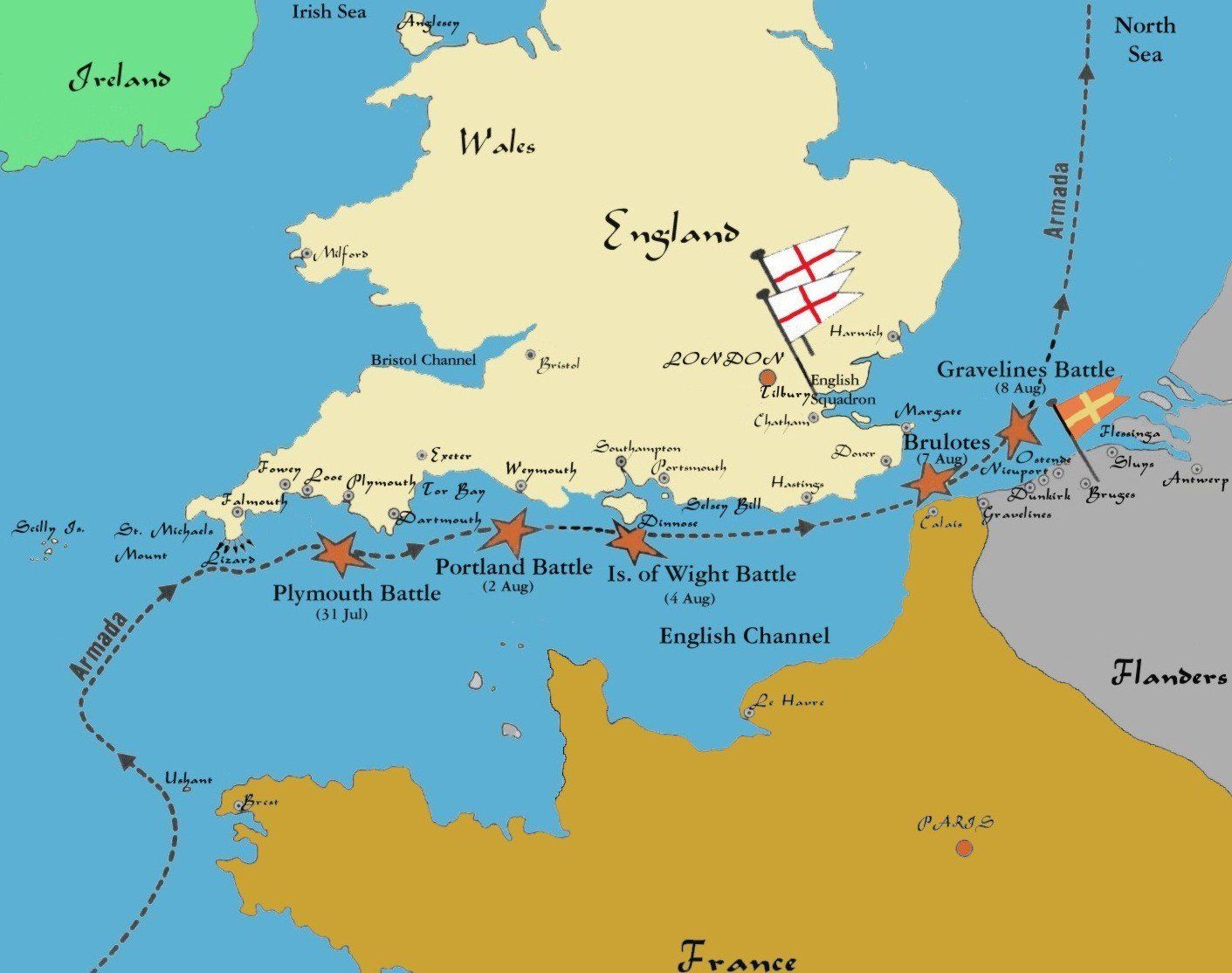
The progress of the Spanish Armada, 1588
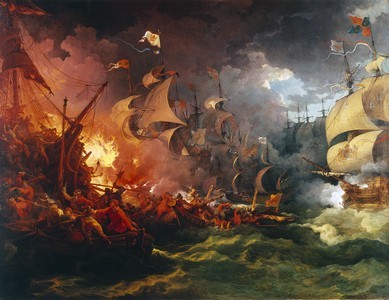
The battle of Gravelines (painted by Loutherbourg)
The fleet was sighted in England on 29th July when it appeared off the coast of Cornwall. The news was quickly sent to London by a system of beacons along the south coast.
By the 3rd/4th August the Spanish were near the Isle of Wight. They wanted to land there to re-supply and wait for word from Parma's army. However the English fleet launched a full-scale attack which persuaded Medina Sidonia to order the Armada back to open sea. There were no more deep water harbours before Calais. By 7th August Medina Sidonia and his fleet had reached Calais where he received the shattering news that the Duke of Parma would not be able to join him at Calais for at least a week.
At midnight on 8th August the English set alight 8 fireships (regular warships filled with gunpowder, tar etc) and set them amongst the closely anchored vessels of the Armada. Medina Sidonia's flagship and the main warships held their positions but the rest of the fleet cut their anchors and scattered in confusion. No Spanish ships were burnt but their crescent formation had been broken. The English now closed in for battle.
This was the day when the most devastating fighting took place. The English fired repeated broadsides into the Spanish ships at close range. After 8 hours, the English ships began to run out of ammunition. 600 Spanish were killed, 3 ships were sunk and many more were badly damaged. The English had lost just 50 men and no ships. The Spanish struggled to match English gunfire - accounts of the battle show that most Spanish ships fired just one or two rounds a day.
However most of the Armada was intact and, with favourable winds, they might still have collected Parma's army and been able to transport it to England.
The 'Protestant' wind blew the Spanish north into the North Sea and away from Parma’s force. The English fleet pursued them up to Scotland. As the Spanish ships headed around the coasts of Scotland and Ireland the wind battered their ships. Just 60 Spanish ships made it back to Spain and 20,000 Spanish lives had been lost.
Not knowing the size of the Spanish defeat at Gravelines 10 days previously, Elizabeth went to Tilbury to review her forces. There she delivered her most famous speech. By 22nd August the English fleet staggered back to port. Diseases were sweeping the English fleet. Many sailors were discharged without their wages. Some lay dying in the streets. Howard and Drake used their own money to pay the sailors but it wasn't enough. A year later, only half of the English sailors who had fought the Spanish were still alive.
The fleet was sighted in England on 29th July when it appeared off the coast of Cornwall. The news was quickly sent to London by a system of beacons along the south coast.
The Armada sailed up the English Channel towards the Isle of Wight. On 30 July, the English fleet tacked upwind of the Armada. The Armada was in a crescent-shaped defensive formation. The English ships used their superior speed and manoeuvrability to keep beyond grappling range and bombarded the Spanish ships from a distance with cannon fire. The English ships formed a line of battle - a line of ships end to end firing cannons against the enemy. Each ship in the line could fire its broadside without fear of hitting a friendly ship. However, no Spanish ships were sunk by the fighting.
After the first day’s skirmishes, Francis Drake went off to loot Rosario - an abandoned Spanish ship. This caused the rest of his fleet to become scattered by dawn. It took a day for the English fleet to regroup. However the English ships again used their superior speed and manoeuvrability to catch up with the Spanish.
By the 3rd/4th August the Spanish were near the Isle of Wight. If they landed there they could re-supply and wait for word from Parma's army. However the English fleet launched a full-scale attack which persuaded Medina Sidonia to order the Armada back to open sea. There were no more deep water harbours before Calais. By 7th August Medina Sidonia and his fleet had reached Calais where he received the shattering news that Parma would not be able to join him at Calais for at least a week. He then ordered his fleet to drop anchor.
At midnight on 8th August the English set alight 8 fireships (regular warships filled with gunpowder, tar etc) and set them amongst the closely anchored vessels of the Armada. Medina Sidonia's flagship and the main warships held their positions but the rest of the fleet cut their anchors and scattered in confusion. No Spanish ships were burnt but their crescent formation had been broken. The English now closed in for battle.
This was to be the day when the most devastating fighting took place. The English fired repeated broadsides into the Spanish ships at close range. After 8 hours, the English ships began to run out of ammunition. 600 Spanish were killed, 3 ships were sunk and many more were badly damaged. The English had lost just 50 men and no ships. The Spanish struggled to match English gunfire - accounts of the battle show that most Spanish ships fired just one or two rounds a day.
However the bulk of the Armada was intact and, with favourable winds, they might still have collected Parma's army and been able to transport it to England.
The 'Protestant' wind blew the Spanish north into the North Sea and away from Parma’s force. The English fleet pursued them up to Scotland and then turned back. As the Spanish ships headed around the coasts of Scotland and Ireland the wind battered their ships. They were running low on supplies and had no accurate maps to guide them. Just 60 Spanish ships made it back to Spain. 20,000 Spanish lives had been lost. More ships and sailors were lost to cold and stormy weather than in direct combat.
Not knowing the scale of the Spanish defeat at Gravelines 10 days previously, Elizabeth went to Tilbury to review her forces. There she delivered her most famous speech. By 22nd August the English fleet staggered back to port. Diseases such as dysentery and typhus were sweeping the English fleet. Many were discharged without their wages and with just a ticket to buy food for the journey home. Some lay dying in the streets of Chatham. Howard and Drake used their own money to pay the sailors but it wasn't enough. A year later, only half of the English sailors who had fought the Spanish were still alive.
The fleet was sighted in England on 29th July when it appeared off the Lizard in Cornwall. The news was conveyed to London by a system of beacons that had been constructed along the south coast.
The Armada decided against attacking the English fleet in Plymouth and the Armada sailed on towards the Isle of Wight. On 30 July, the English fleet tacked upwind of the Armada. The Armada was in a crescent-shaped defensive formation. The English ships used their superior speed and manoeuvrability to keep beyond grappling range and bombarded the Spanish ships from a distance with cannon fire. The English ships formed a line of battle - a line of ships end to end firing cannons against the enemy. Each ship in the line could fire its broadside without fear of hitting a friendly ship. However, no Spanish ships were sunk by the fighting.
After the first day’s skirmishes, Francis Drake went off to loot Rosario - an abandoned Spanish ship. This caused the rest of his fleet to become scattered and disarrayed by dawn. It took a day for the English fleet to regroup and the Armada gained a day’s advantage. However the English ships again used their superior speed and manoeuvrability to catch up with the Spanish.
By the 3rd/4th August the Spanish were near the Isle of Wight. If they landed there they could re-supply and wait for word from Parma's army. However the English fleet launched a full-scale attack which persuaded Medina Sidonia to order the Armada back to open sea. There were no more deep water harbours before Calais. By 7th August Medina Sidonia and his fleet had reached Calais where he received the shattering news that Parma would not be able to join him at Calais for at least a week. He then ordered his fleet to drop anchor.
At midnight on 8th August the English set alight 8 fireships (regular warships filled with gunpowder, tar etc) and set them amongst the closely anchored vessels of the Armada. Medina Sidonia's flagship and the main warships held their positions but the rest of the fleet cut their anchors and scattered in confusion. No Spanish ships were burnt but their crescent formation had been broken. The English now closed in for battle.
This was to be the day when the most devastating fighting took place. The English fired repeated broadsides into the Spanish ships at close range. After 8 hours, the English ships began to run out of ammunition. 600 Spanish were killed, 3 ships were sunk and many more were badly damaged. The English had lost just 50 men and no ships. The Spanish struggled to match English gunfire - accounts of the battle show that most Spanish ships fired just one or two rounds a day.
However the bulk of the Armada was intact and, with favourable winds, they might still have collected Parma's army and been able to transport it to England.
The 'Protestant' wind blew the Spanish north into the North Sea and away from Parma’s force. The English fleet pursued them up to Scotland and then turned back. As the Spanish ships headed around the coasts of Scotland and Ireland the wind battered their ships. They were running low on supplies and had no accurate maps to guide them. Just 60 Spanish ships made it back to Spain. 20,000 Spanish lives had been lost for nothing. More ships and sailors were lost to cold and stormy weather than in direct combat.
Not knowing the scale of the Spanish defeat at Gravelines 10 days previously, Elizabeth went to Tilbury to review her forces. There she delivered her most famous speech. By 22nd August the English fleet staggered back to ports in Dover and Chatham. Diseases such as dysentery and typhus were sweeping the English fleet. Many were discharged without the wages they were owed and with just a ticket to buy food for the journey home. Some lay dying in the streets of Chatham. Howard and Drake used their own money to pay the sailors but it wasn't enough. A year later, only half of the English sailors who had fought the Spanish were still alive.