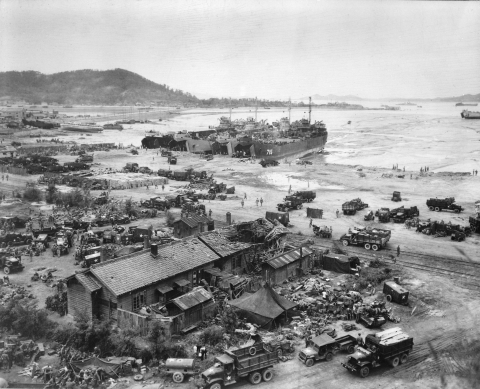
UN troops, made up mostly of US soldiers, were first sent to protect the city of Pusan in the South. Then, in September 1950,
General MacArthur led the UN invasion, starting with a landing at Inchon Bay, near Seoul, 150 miles behind enemy lines. This was very successful and by October,
all North Korean troops had been driven back beyond the 38th parallel.
Chinese Troops counter-attack
The US led force then invaded North Korea, believing that China would not intervene. They were wrong. In October China
sent in 200 000 troops, equipped with Soviet tanks and weapons. The Chinese counter-attack drove the UN back and China successfully
captured Seoul. By March 1951, however, the US-UN force had recaptured Seoul and both sides were back where they had started –
either side of the 38th parallel.
Stalemate 1951-1953
President Truman did not want to escalate the war further so he ordered the UN troops not to attack North Korea. He then sacked
General MacArthur because he publicly criticised this policy and also hinted that the US should use nuclear bombs against China.
From 1951 – 1953 both sides dug in defensively facing each other across the 38th parallel. However the war in the air
continued. The US bombed North Korea including using napalm. The Chinese sought help from the USSR who supplied planes but painted them
in Chinese colours to hide their own involvement. The UN lost 3 500 planes whilst the USSR lost 3 000.
Stages of the Korean War - revision video
The front line in the Korean War went up and down like a yo-yo between 1950 and 1951 with Seoul (the capital of South Korea) changing hands 4 times. There was then stalemate for 2 years with massive bombardment from the air but without any movement on the ground.
War of Movement 1950 - 1951
North Korea invaded South Korea, driving the South Koreans out of most of the country.
The US led a United Nations force that drove the North Koreans out of South Korea (including the famous Inchon Bay landing).
The UN force advanced well into North Korea, close to the Chinese border. This brought the Chinese into the war who drove the UN back into South Korea.
The UN counter-attacked and recaptured Seoul.
Stalemate developed with both sides close to the original 38th parallel.
Stalemate 1951 - 1953
Both sides dug in with very strong defences so not much happened in the ground war. However the US and UN bombed North Korea and each side lost over 3000 planes.
The front line in the Korean War went up and down like a yo-yo between 1950 and 1951 with Seoul (the capital of South Korea) changing hands 4 times. There was then stalemate for 2 years with massive bombardment from the air but without any movement on the ground.
War of Movement 1950 - 1951
June 1950: North Korea invaded South Korea, driving the South Koreans out of most of the country apart from Pusan province in the South.
Sept 1950: The US led a United Nations force that drove the North Koreans out of South Korea (including the famous Inchon Bay landing).
Oct 1950: The UN force advanced well into North Korea, capturing the North Korean capital of Pyongyang and approaching the Chinese border. This brought the Chinese into the war who sent in 200,000 troops and drove the UN back into South Korea, capturing Seoul in January 1951.
Mar 1951: The UN counter-attacked and recaptured Seoul.
Stalemate developed with both sides close to the original 38th parallel.
Stalemate 1951 - 1953
From April 1951, both sides dug in with very strong defences so not much happened in the ground war. However the US and UN bombed North Korea and each side lost over 3000 planes.
Inchon Bay Landing
UN troops, made up mostly of US soldiers, were first sent to protect the city of Pusan in the South. Then, in September 1950,
General MacArthur led the UN invasion, starting with a landing at Inchon Bay, near Seoul, 150 miles behind enemy lines. This was very successful and by October,
all North Korean troops had been driven back beyond the 38th parallel.
Chinese Troops counter-attack
The US led United Nations force then invaded North Korea, believing that China would not intervene. They were wrong. UN forces almost reached the Yalu river and in Oct 1950 China sent in 200 000 troops, equipped with Soviet tanks and weapons. The Chinese counter-attack drove the UN back and China successfully
captured Seoul. By March 1951, however, the US-UN force had recaptured Seoul and both sides were back where they had started –
either side of the 38th parallel.
Stalemate 1951-1953
President Truman did not want to escalate the war further so he ordered the UN troops not to attack North Korea. He then sacked
General MacArthur because he publicly criticised this policy and also hinted that the US should use nuclear bombs against China.
From 1951 – 1953 both sides dug in defensively facing each other across the 38th parallel. However the war in the air
continued. The US bombed North Korea including using napalm. The Chinese sought help from the USSR who supplied planes but painted them
in Chinese colours to hide their own involvement. The UN lost 3 500 planes whilst the USSR lost 3 000.