

1543 |
Middle Ages |
The Renaissance |
Industrial Revolution |
Twentieth Century |
Andreas Vesalius
Andreas Vesalius was an expert in anatomy:
- He was the first person to perform human dissections and produce detailed, accurate drawings of the human body.
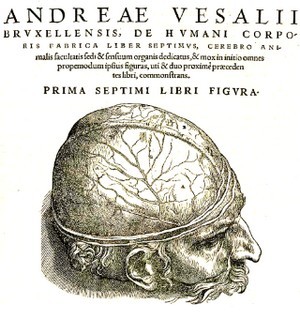
- He published his book, On the Fabric of the Human Body, in 1543.
- He proved Galen wrong in over 200 different ways. For example, Vesalius showed that the lower human jaw bone is only one bone and not two as Galen had thought. He also proved that blood cannot flow from one side of the heart to the other through the septum.
Significance
Before Vesalius doctors accepted Galen's ideas on anatomy. These weren't completely wrong but they were full of mistakes as Galen had mostly studied animals. After Vesalius, doctors realised that they needed to test everything that Galen wrote and perform human dissections for themselves. His significance was therefore:
- Specific: he furthered understanding of areas of anatomy.
- General: he ended the stagnation of medicine by encouraging doctors to challenge everything they had learnt from ancient sources and to find out things for themsleves.
Factors that helped:
- Individual Genius - risk-taking, questioning accepted ideas;
- Education - atmosphere at Padua university encouraged new discoveries;
- Technology - skilled artists could draw his findings;
- Communication - the invention of the printing press (1450) meant Vesalius could share his ideas;
- Religion - the decline in the power of the Church meant that it became possible to dissect human bodies;