

1854 |
Middle Ages |
The Renaissance |
Industrial Revolution |
Twentieth Century |
John Snow
Cholera
John Snow was a doctor who challenged the idea that disease was caused by miasma. He proved that cholera was spread through contaminated water in 1854.
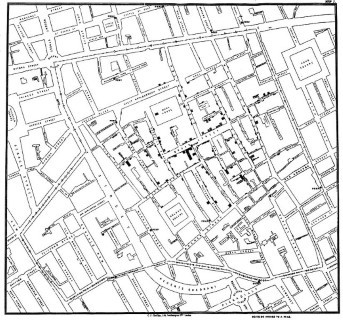
During the cholera outbreak in London in 1854, Snow carried out detailed research, interviewing the residents of Soho about their lifestyle and plotting the number of deaths on a map. He found that those that had drunk water from the pump on Broad Street became ill whereas those who lived in the same area but drunk water from elsewhere did not. Although the authorities were reluctant to believe him, he managed to persuade them to remove the handle of the Broad Street pump and the cholera outbreak stopped.
Significance: Snow's work with cholera helped lead to the building of London's sewers in the 1860s and to the 1875 Public Health Act. Snow was unable to prove how dirty water spread cholera and so his ideas were slow to be accepted. However, he is often thought of today as the father of epidemiology (the study of the spread and control of disease).
Anaesthetics
John Snow also developed a safe way to administer chloroform during surgery. He discovered that some patients died from a chloroform overdose during surgery because they breathed in too much. He designed a chloroform inhaler in 1848 which enabled him to administer the anaesthetic safely over 4000 times, including to Queen Victoria at the birth of two of her children in 1853 and 1857.