

1575 |
Middle Ages |
The Renaissance |
Industrial Revolution |
Twentieth Century |
Renaissance Surgery
Surgery in the Renaissance was still basic and dangerous, with the main problems of pain, infection and blood loss remaining. However, there was some progress. In 1540, the Company of Barber-Surgeons was formed by Henry VIII which made the profession more respected.
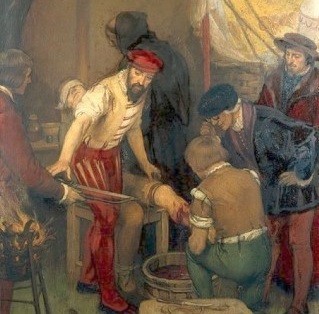
Ambroise Paré was a French army surgeon who made several important advances:
- He developed an ointment to help wounds heal rather than using boiling oil.
- He used ligatures (silk threads) to tie up blood vessels rather than cauterising them (sealing them with a hot iron). Unfortunately, as they were not sterile, these would often spread infection deeper into the body.
- He argued that gunshot wounds were not poisonous.
- He developed the crow's beak clamp to close blood vessels so they could be tied off.
Paré published his book, Works on Surgery in 1575. He included sections of Vesalius' work on anatomy and by translating these into French he greatly increased surgeons' understanding of anatomy as most surgeons didn't know Latin. An English copy of Paré's book was given to the library of the Barber-Surgeons in 1591.
In 1745 the Company of Surgeons was formed (separate from Barber-Surgeons) which further enhanced the reputation of this branch of medicine.