

1543 |
Middle Ages |
The Renaissance |
Industrial Revolution |
Twentieth Century |
Anatomy in the Renaissance
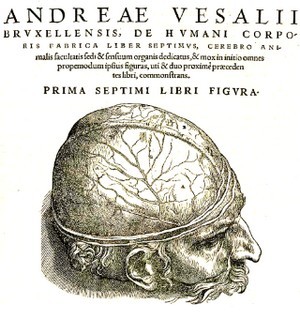
Vesalius was an expert in anatomy. He was the first person to perform human dissections and produce detailed, accurate drawings
of the human body. He published his book in the 1500s during the Renaissance. He proved Galen wrong in over 200 different ways. For example, Vesalius
showed that the lower human jaw bone is only one bone and not two as Galen had thought.
Significance
Before Vesalius doctors accepted Galen's ideas on anatomy. After Vesalius, doctors realised that they needed to test everything that Galen wrote
and perform human dissections for themselves.
Factors that helped:
- Individual Genius - questioning accepted ideas;
- Education - atmosphere at Padua university encouraged new ideas;
- Technology (skilled artists could draw his findings;
- Communication - the printing press meant he could share his ideas;
Harvey
Harvey discovered that the heart is a pump and that blood flows around the body in one direction - away from the heart in arteries and back to the heart in veins. Before Harvey, people accepted Galen's belief that blood was made in the liver and was consumed by the body like wood in fire.
Harvey was important because:
- he proved Galen wrong
- he showed how the blood circulation system works
- he promoted scientific method - carrying out experiments and making detailed measurements
Vesalius and Harvey transformed understanding of anatomy during the Renaissance. However, their ideas did not help people in the short-term because surgeons did not have the knowledge or expertise and modern drugs were not available.