Penicillin had been discovered several times, but the first person to publish an article about its potential was Alexander Fleming. He discovered it by accident when he was washing up old petri dishes and noticed that bacteria had not grown around the penicillium mould.
Nothing happened for several years until Howard Florey and Ernst Chain read Fleming’s article and investigated further. They then spent years developing the idea into a drug.
Key Events:
1940 - experiment on mice.
1941 - experiment on a policeman. They ran out of penicillin and so he died, but it had proved the drug’s potential.
1944 - enough produced to treat the D Day casualties.
Factors that enabled the development of penicillin:
Chance - that Fleming noticed the mould when washing up.
Individual genius - as Pasteur said, chance favours the mind that is prepared.
Teamwork.
War - led to funding.
Government - the US gave $80m.
Industry - industrial chemists helped mass produce the drug.
Significance:
Penicillin was the first antibiotic. This family of drugs has successfully conquered most infectious disease and saved countless lives. Overuse of antibiotics in medicine and in farming, however, is leading to some "superbugs" that are becoming resistant to antibiotics.
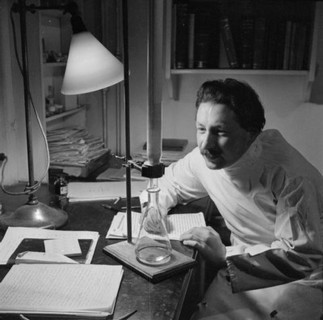
Ernst Chain, a key member of the team that developed penicillin as a drug, working in Oxford in 1944.
The 1940 mice experiment was a key turning point in proving that the mould worked as a medicine in a living creature. But penicillin is toxic to guinea pigs so it's a good thing they didn't test it on them.
How was penicillin discovered?
Alexander Fleming discovered penicillin by accident in 1928 when he was washing up old petri dishes and noticed that bacteria had not grown around the mould. He published an article about it the next year.
How was penicillin developed into a medicine?
Nothing happened for several years until Florey and Chain read Fleming’s article and investigated further. They then spent years developing the idea into a drug.
Key Events:
1940 - experiment on mice proved that the mould worked as a medicine in a living creature.
1941 - experiment on a policeman. They ran out of penicillin and so he died, but it proved the drug’s potential.
1944 - penicillin was mass produced with enough doses to treat the D Day casualties in World War II.
Factors that enabled the development of penicillin:
Factors that enabled the development of penicillin:
Chance - that Fleming noticed the mould when washing up.
Individual genius - Fleming noticed the potential of penicillin and Florey and Chain worked brilliantly to develop it.
Teamwork.
War - led to funding as it was hoped it would help to win WWII.
Government - the US gave $80m.
Industry - industrial chemists helped mass produce the drug.
Significance:
Penicillin was the first antibiotic. This group of drugs means that most infectious diseases can now be cured, saving millions of lives every year.
How was penicillin discovered?
Penicillin had been discovered several times, but the first person to publish an article about its potential was Alexander Fleming. He discovered it by accident when he was washing up old petri dishes and noticed that bacteria had not grown around the penicillium mould.
How was penicillin developed into a medicine?
Nothing happened for several years until Howard Florey and Ernst Chain read Fleming’s article and investigated further. They then spent years developing the idea into a drug.
Key Events:
1940 - experiment on mice proved that the mould worked as a medicine in a living creature.
1941 - experiment on a policeman. They ran out of penicillin and so he died, but it proved the drug’s potential.
1944 - penicillin was mass produced with enough doses to treat the D Day casualties in World War II.
Factors that enabled the development of penicillin:
Chance - that Fleming noticed the mould when washing up.
Individual genius - of Fleming (as Pasteur said, "chance favours the mind that is prepared.") Also of Florey and Chain.
Teamwork - modern medical research needs teams to conduct experiments.
War - led to funding in the hope that the drug could be used to treat casualties.
Government - the US gave $80m to mass-produce the drug.
Industry - industrial chemists helped mass-produce the drug.
Significance:
Penicillin was the first antibiotic. This group of drugs means that most infectious diseases can now be cured, saving millions of lives every year. Overuse of antibiotics in medicine and in farming, however, is leading to some "superbugs" that are becoming resistant to antibiotics.
How was penicillin discovered?
Penicillin had been discovered several times, but the first person to publish an article about its potential was Alexander Fleming. He discovered it by accident when he was washing up old petri dishes and noticed that bacteria had not grown around the penicillium mould.
How was penicillin developed into a medicine?
Nothing happened for several years until Howard Florey and Ernst Chain read Fleming’s article and investigated further. They then spent years developing the idea into a drug.
Key Events:
1940 - experiment on mice proved that the mould worked as a medicine in a living creature.
1941 - experiment on a policeman, Albert Alexander. They ran out of penicillin and so he died, but it proved the drug’s potential.
1944 - penicillin was mass produced with enough doses to treat the D Day casualties in World War II. By 1945 250,000 soldiers had been treated.
Factors that enabled the development of penicillin:
li>Chance - that Fleming noticed the mould when washing up.
Individual genius - of Fleming (as Pasteur said, "chance favours the mind that is prepared.") Also of Florey and Chain.
Teamwork - modern medical research needs teams to conduct experiments.
War - led to funding in the hope that the drug could be used to treat casualties.
Government - at first the UK government only gave £25 as resources were needed for the war. Florey then lobbied the US government who gave $80m to mass-produce the drug.
Industry - industrial chemists helped mass-produce the drug, including the modern pharmaceutical company Pfizer. The modern
Significance:
Penicillin was the first antibiotic. It possibly prevented 15% of UK and US WWII casualties from dying. This group of drugs means that most infectious diseases can now be cured, saving millions of lives every year. New antibiotics have been discovered since, such as streptomycin in 1944. Overuse of antibiotics in medicine and in farming, however, is leading to some "superbugs" that are becoming resistant to antibiotics.