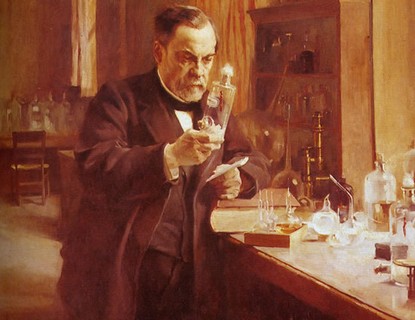
Louis Pasteur
Pasteur proved that germs cause disease in 1861. This was a massive breakthrough which eventually led to vaccinations and treatments, although these took time. Pasteur was an industrial chemist. He discovered that beer was going bad because of the germs in it and that if he heated the beer, the germs would die. He carried out experiments to prove that germs cause decay and he proved that germs cause disease in silk worms.
Robert Koch
Robert Koch was a German scientist who proved that germs cause disease in humans. He identified the particular bacterium that causes anthrax. He did this by injecting 20 generations of mice with the same germ and extracting it each time. This gave other doctors a method to use to discover other bacteria.
Pasteur and Koch went on to develop new vaccinations, for example for tuberculosis.
Factors that helped
- Technology - a powerful microscope was invented in the 1820s which enabled scientists to study bacteria;
- Individual genius - Pasteur and Koch were both methodical and determined;
- Government funding - both Pasteur and Koch had well-funded research teams;
- War - rivalry between Prussia (Germany) and France led to government funding;
- Teamwork - individuals now needed a whole team to help them.
Louis Pasteur was an industrial chemist who proved germ theory - the idea that disease is caused by micro-organisms. He discovered that beer was going bad because of the germs in it and that if he heated the beer, the germs would die. This led to the process of pasteurisation. He conducted experiments to prove that germs cause decay and he went on to prove that germs caused disease in animals - silk worms - but he did not prove germ theory in humans. He also developed the second vaccination, for chicken cholera, and the third for anthrax in sheep.
Factors that helped:
- Individual genius - careful observation and determination;
- Technology - Joseph Jackson Lister’s microscope of 1826 enabled scientists to study bacteria clearly;
- Government funding - both Pasteur and Koch had well-funded research teams;
- War - rivalry between Prussia (Germany) and France led to government funding;
- Teamwork - individuals now needed a whole team to help them.
- Chance - the accidental discovery of the chicken cholera vaccine by his assistant;
Pasteur published his germ theory in 1861. It took about twenty years to be widely accepted and this was only after the work of Tyndall who publicly defended it and Koch who proved it beyond doubt. From the 1880s, Germ Theory was hugely influential, affecting nearly every aspect of medicine including public health, surgery, hospitals, training and treatments.
Louis Pasteur was an industrial chemist who proved germ theory - the idea that disease is caused by micro-organisms. He discovered that beer was going bad because of the germs in it and that if he heated the beer, the germs would die. This led to the process of pasteurisation. He conducted experiments to prove that germs cause decay and he went on to prove that germs caused disease in animals - silk worms - but he did not prove germ theory in humans. He also developed the second vaccination, for chicken cholera, and the third for anthrax in sheep.
Factors that helped:
- Individual genius - careful observation and determination;
- Technology - Joseph Jackson Lister’s microscope of 1826 enabled scientists to study bacteria clearly;
- Government funding - both Pasteur and Koch had well-funded research teams;
- War - rivalry between Prussia (Germany) and France led to government funding;
- Teamwork - individuals now needed a whole team to help them.
- Chance - the accidental discovery of the chicken cholera vaccine by his assistant;
Pasteur published his germ theory in 1861. It took about twenty years to be widely accepted and this was only after the work of John Tyndall who publicly defended it and Koch who proved it beyond doubt. In Britain, Germ Theory was accepted from 1879 when William Cheyne (an assistant of Joseph Lister) translated Koch's work into English.
From then on, Germ Theory was transformational, affecting nearly every aspect of medicine including public health, surgery, hospitals, training and treatments.