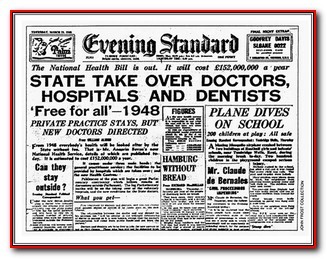
The National Health Service (NHS) is a free-to-use system that covers all aspects of healthcare. The NHS finally enabled all people in the UK to access healthcare. It opened in 1948. National Insurance had provided a scheme to enable those in work to see a doctor but it didn’t cover the unemployed, children, the elderly or most women.
The NHS meant that the government took over all hospitals and employed all doctors and staff directly.
Opposition
The plans were strongly opposed by the BMA (the doctors’ union) and groups that ran hospitals. They argued that giving people something for nothing was morally wrong. The doctors were also worried that their pay would go down.
How Opposition was overcome
- Individual genius - the Minister for Health, Bevan gave concessions to the doctors, such as allowing them to do private work in NHS hospitals.
- War - after WWII there was a feeling that the country should unite to defeat poverty. The war had also led to re-organising healthcare.
- Government - after WWII a Labour government was elected with a huge majority as many people now wanted a government that would address poverty.
- Wealth - it was expensive, but the country could now afford it.
The National Health Service (NHS) was the first time that all people in the UK could access healthcare. It opened in 1948. In 1911, National Insurance provided a scheme to enable those in work to see a doctor but it didn’t cover the unemployed, children, the elderly or most women.
The NHS meant that the government took over all hospitals and employed all doctors and staff directly.
Opposition
The plans were strongly opposed by the BMA (the doctors’ union) and groups that ran hospitals. They argued that giving people something for nothing was morally wrong. The doctors were also worried that their pay would go down.
How Opposition was overcome
- Individual genius - the Minister for Health, Aneurin (Nye) Bevan was determined and a charismatic speaker. He gave concessions to the doctors, such as allowing them to do private work in NHS hospitals.
- War - after WWII there was a feeling that the country should unite to defeat poverty. The war had also led to re-organising healthcare and the Beveridge Report of 1942 set out how healthcare should be organised after the war - effectively a blueprint for the NHS.
- Government - after WWII a Labour government was elected with a huge majority as many people now wanted a government that would address poverty.
- End of Laissez-Faire - during the war the government had interfered in every aspect of people's lives, even suggesting what they should eat as part of rationing. Most people now accepted government interference in a good cause.
- Wealth - it was expensive, but the country could afford it due to rising prosperity.
The National Health Service (NHS) was the first time that all people in the UK could access healthcare. It opened in 1948. In 1911, National Insurance provided a scheme to enable those in work to see a doctor but it didn’t cover the unemployed, children, the elderly or most women.
The NHS meant that the government took over all hospitals and employed all doctors and staff directly.
Opposition
The plans were strongly opposed by the BMA (the doctors’ union) and groups that ran hospitals. They argued that giving people something for nothing was morally wrong. The doctors were also worried that their pay would go down.
How Opposition was overcome
- Individual genius - the Minister for Health, Aneurin (Nye) Bevan was determined and a charismatic speaker. He gave concessions to the doctors, such as allowing them to do private work in NHS hospitals.
- War - after WWII there was a feeling that the country should unite to defeat poverty. The war had also led to re-organising healthcare and the Beveridge Report of 1942 set out how healthcare should be organised after the war - effectively a blueprint for the NHS.
- Government - after WWII a Labour government was elected with a huge majority as many people now wanted a government that would address poverty.
- End of Laissez-Faire - during the war the government had interfered in every aspect of people's lives, even suggesting what they should eat as part of rationing. Most people now accepted government interference in a good cause.
- Wealth - it was expensive, but the country could afford it due to rising prosperity.