

1875 |
Middle Ages |
The Renaissance |
Industrial Revolution |
Twentieth Century |
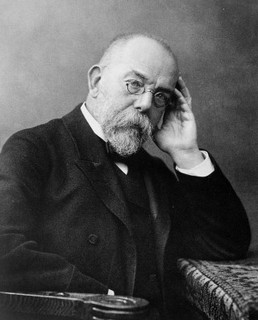
Robert Koch
Robert Koch was a German scientist. He proved Pasteur's germ theory correct in humans by identifying the particular bacterium that causes anthrax in 1875. He did this by injecting 20 generations of mice with the same germ and extracting it each time. This gave other doctors a method to use to discover other bacteria.
Koch and his team went on to develop new vaccinations, for example for tuberculosis. He also identified the septicaemia bacterium in 1878 which proved why Lister's antiseptic surgery worked. Koch developed a jelly (or medium) which made it easier to cultivate bacteria and a stain which made it easier to study them.
Factors that helped
- Individual genius - very methodical
- Technology - the microscope
- Government funding
- War - rivalry between Prussia and France led to government funding
- Teamwork - individuals now needed a whole team to help them.
By the 1880s, English doctors and scientists accepted germ theory. A key stage in convincing them was when Cheyne translated Koch's work into English. From this point, scientists began to look for new vaccines and ways of treating infectious diseases. Robert Ehrlich, who discovered the first magic bullet, was one of Koch's assistants.