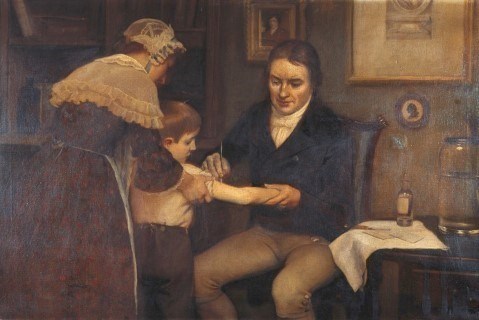
Smallpox was one of the biggest killers. In the 1700s, inoculation gave basic protection by giving people a small amount of the disease - but if the dose was too big, they would catch the disease and if it was too small then they would not be protected.
Jenner discovered that infecting patients with cowpox protected them against smallpox. This was the first vaccination.
Factors that helped:
- Individual Genius (attention to detail; risk-taking);
- Chance (that he moved to Gloucester);
- Communication (his idea built on inoculation that had originally come from abroad);
- Government (finally made smallpox vaccination compulsory in 1871);
Significance of the Smallpox Vaccination
| Very significant |
Not very significant |
| Saved millions of lives. |
Jenner couldn't explain how it worked so no-one could make a vaccine for different diseases. |
| Gave future doctors the idea of vaccination. |
In the short term there was a lot of opposition so it took time for it to be effective. |
Smallpox was one of the world"s biggest killers, with up to 300 million people dying from it worldwide in the twentieth century. In the 1700s, inoculation was brought to England from Turkey. This involved infecting people with a small dose of the disease to give them protection. This often worked, but if the dose was too big, they would catch the disease and if it was too small then they would not be protected.
In 1796 Jenner discovered that infecting patients with cowpox protected them against smallpox. This was the first vaccination. He demonstrated his ideas through experiments but the Royal Society refused to publish his work because he couldn't explain how it worked.
Factors that helped:
- Individual Genius (attention to detail; risk-taking);
- Chance (that he moved to Gloucester);
- Communication (his idea built on inoculation that had originally come from abroad);
- Government (gave Jenner £30 000 to open a clinic and then passed various laws promoting the vaccine, finally making vaccination compulsory in 1871);
Opposition
Jenner was opposed because:
- Money - inoculators made profit from the old methods and didn't want to lose business.
- Conservatism - people were slow to accept new ideas, especially one as strange as using matter from an animal disease.
- Science - the scientific revolution focused on evidence and Jenner couldn't explain how his vaccination worked.
Significance of the Smallpox Vaccination
| Very significant |
Not very significant |
| Saved millions of lives. |
Jenner couldn't explain how it worked so no-one could make a vaccine for different diseases. |
| Gave future doctors the idea of vaccination. |
In the short term there was a lot of opposition so it took nearly a hundred years to dramatically reduce deaths in England. |
Smallpox was one of the world"s biggest killers, accounting for around 10% of deaths in Jenner's time and responsible for up to 300 million deaths worldwide in the twentieth century. In the 1700s, inoculation was brought to England from China via Turkey. This involved infecting people with a small dose of the disease to give them protection. This often worked but if the dose was too big, they would catch the disease and if it was too small then they would not be protected.
In 1796 Jenner discovered that infecting patients with cowpox protected them against smallpox. This was the first vaccination. He demonstrated his ideas through experiments (e.g. on the 8 year old James Phipps), but the Royal Society refused to publish his work as he couldn't explain how it worked.
Factors that helped:
- Individual Genius (attention to detail; risk-taking);
- Chance (that he moved to Gloucester);
- Communication (his idea built on inoculation that had originally come from abroad);
- Government (gave Jenner £30 000 to open a clinic and then passed various laws promoting the vaccine, finally making vaccination compulsory in 1871);
Opposition
Jenner was opposed because:
- Money - inoculators made profit from the old methods and didn't want to lose business.
- Conservatism - people were slow to accept new ideas, especially one as strange as using matter from an animal disease.
- Science - the scientific revolution focused on evidence and Jenner couldn't explain how his vaccination worked.
Significance of the Smallpox Vaccination
| Very significant |
Not very significant |
| Saved millions of lives. In 1980 smallpox became the first (and currently only) disease to be eradicated globally by the World Health Organisation. |
Jenner couldn't explain how it worked so no-one could make a vaccine for different diseases. |
| Gave future doctors the idea of vaccination. |
In the short term there was a lot of opposition so it took nearly a hundred years to dramatically reduce deaths in England. |