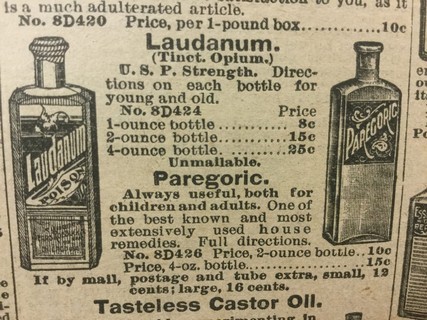
Treatments for most of the industrial revolution were ineffective. Herbal remedies were still used widely. By the late 1800s, thanks to the growing chemical industry, there was a huge range of patent medicines. A small number, like aspirin, worked but most didn't and some, like laudanum were really dangerous. Following the work of Pasteur and Koch, by the end of the 1800s there were a few effective treatments, such as the serum for diptheria which Lister introduced to Britain in 1895: within 10 years the death rate halved.
Most poor people were still treated at home, but dispensaries provided free advice and medicine to the poor.
Some popular remedies like laudanum were highly toxic.
Treatments for most of the industrial revolution were ineffective. Herbal remedies were still used widely. By the late 1800s, thanks to the growing chemical industry, there was a huge range of patent medicines. These were branded cures, sold without a prescription. A small number, like aspirin, worked but most didn't and some, like laudanum were really dangerous.
Most poor people were still treated at home, but dispensaries now provided free advice and medicine to the poor.
Treatments for most of the industrial revolution were ineffective. Herbal remedies were still used widely. By the late 1800s, thanks to the growing chemical industry, there was a huge range of patent medicines. These were branded cures, sold without a prescription. A small number, like aspirin, worked but most didn't and some, like laudanum were really dangerous. There were no controls about what ingredients could be used. Following the work of Pasteur and Koch, by the end of the 1800s there were a few effective treatments, such as the serum for diptheria.
Most poor people were still treated at home, but dispensaries now provided free advice and medicine to the poor. However, infant mortality rates remained very high.
Treatments for most of the industrial revolution were ineffective. Herbal remedies were still used widely. By the late 1800s, thanks to the growing chemical industry, there was a huge range of patent medicines. These were branded cures, sold without a prescription. A small number, like aspirin, worked but most didn't and some, like laudanum were really dangerous. There were no controls about what ingredients could be used. Following the work of Pasteur and Koch, by the end of the 1800s there were a few effective treatments, such as the serum for diptheria which Lister introduced to Britain in 1895: within 10 years the death rate halved. In 1899, Paul Ehrlich began a new scientific approach to developing medicines, searching for magic bullets (cures for specific diseases).
Most poor people were still treated at home, but dispensaries now provided free advice and medicine to the poor. However, infant mortality rates remained very high - about 16%.