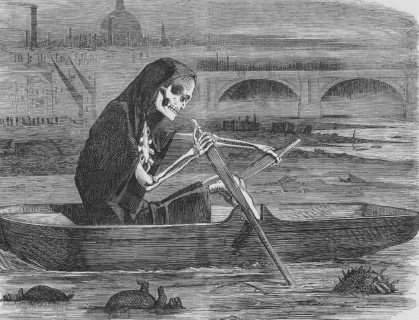
Public Health became much worse in the cities during the Industrial Revolution. As towns grew in size, the streets became more and more filthy and the towns couldn't cope with the amount of animal and human sewage. Life expectancy fell with half of children in the poorest towns not reaching their fifth birthday and life expectancy in the poorest part of Leeds was just 19. Public Health was so bad because of:
Massive population growth and urbanisation - the population of England increased six fold from 1700 - 1900 and more people moved from the countryside to the towns;
Lack of scientific understanding: no—one knew for sure how to stop diseases spreading, miasma was the most popular theory;
Laissez-Faire: Government did not believe that it was their job to improve the lives of ordinary people. The poor also had no political power as they could not vote until 1867;
Money: any attempt to clean up the towns would be very expensive; houses were built as cheaply as possible as workers were poor;
Lack of Building Regulations: there were no laws to ensure that houses were safe or hygienic;
The Great Stink drew attention to the public health crisis.
Public Health became much worse in the cities during the Industrial Revolution. As towns grew in size, the streets became more and more filthy and the towns couldn't cope with the amount of animal and human sewage. Life expectancy fell with half of children in the poorest towns not reaching their fifth birthday. Public Health was so bad because of:
Massive population growth;
Lack of scientific understanding: no—one knew for sure how to stop diseases spreading;
Government worked for the rich and didn't care about the lives of the poor;
Public Health became much worse in the cities during the Industrial Revolution. As towns grew in size, the streets became more and more filthy and the towns couldn't cope with the amount of animal and human sewage. Life expectancy fell with half of children in the poorest towns not reaching their fifth birthday and life expectancy in the poorest part of Leeds was just 19. Public Health was so bad because of:
Massive population growth and urbanisation - the population of England increased six fold from 1700 - 1900 and more people moved from the countryside to the towns;
Lack of scientific understanding: no—one knew for sure how to stop diseases spreading, miasma was the most popular theory;
Laissez-Faire: Government did not believe that it was their job to improve the lives of ordinary people. The poor also had no political power as they could not vote;
Money: any attempt to clean up the towns would be very expensive; houses were built as cheaply as possible as workers were poor;
Lack of Building Regulations: there were no laws to ensure that houses were safe or hygienic;
Public Health became much worse in the cities during the Industrial Revolution. As towns grew in size, the streets became more and more filthy and the towns couldn't cope with the amount of animal and human sewage. Life expectancy fell with half of children in the poorest towns not reaching their fifth birthday and life expectancy in the poorest part of Leeds was just 19. Public Health was so bad because of:
Massive population growth and urbanisation - the population of England increased six fold from 1700 - 1900 and more people moved from the countryside to the towns;
Lack of scientific understanding: no—one knew for sure how to stop diseases spreading, miasma was the most popular theory;
Laissez-Faire: Government did not believe that it was their job to improve the lives of ordinary people. The poor also had no political power as they could not vote until 1867;
Money: any attempt to clean up the towns would be very expensive; houses were built as cheaply as possible as workers were poor;
Lack of Building Regulations: there were no laws to ensure that houses were safe or hygienic;