

1628 |
Middle Ages |
The Renaissance |
Industrial Revolution |
Twentieth Century |
William Harvey
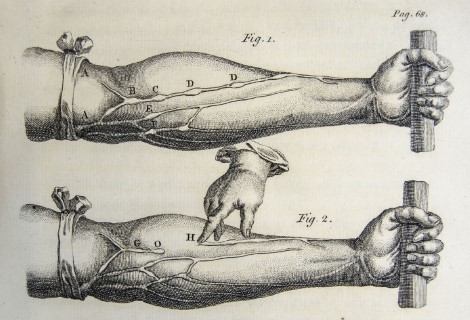
William Harvey was an English doctor who discovered that the heart is a pump and that blood flows around the body in one direction - away from the heart in arteries and back to the heart in veins. Before Harvey, people accepted Galen's belief that blood was made in the liver and was consumed by the body like wood in fire. Harvey even suggested that capillaries must exist although they were too small for him to see them. This was proved a few years after his death when van Leeuwenhoek developed a better microscope. Harvey published his book, On the Motion of the Heart and Blood in Animals, in 1628.
Harvey was important because:
- He proved Galen wrong (again);
- he showed how the blood circulation system works;
- he promoted scientific method - carrying out experiments and making detailed measurements;
Vesalius and Harvey transformed understanding of anatomy (how the body fits together) and physiology (how the body works) during the Renaissance. However, their ideas did not help people in the short-term because surgeons did not have the knowledge or expertise and modern drugs were not available. They also had nothing to say about what caused disease.