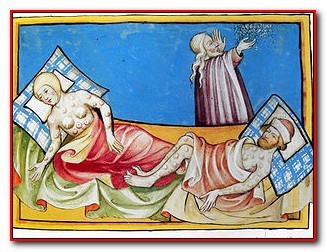
The Black Death was a terrible plague that swept across Europe and came to England in the 1300s. The bubonic plague was spread by rats as well as from person to person. About 40% of the population died.
Beliefs about causes
No-one knew what caused it. Many people believed that it was sent as a punishment from God; others blamed miasma (bad air) or the movement of the planets (astrology).
Treatments
Treatments were basic and ineffective, for example balancing the humours by blood-letting, lancing the buboes or eating cooked onions. Some people tried to prevent the disease by lighting fires to purify the air and others relied on prayer.
Consequences of the Black Death
After the Black Death, small improvements were made to public health. For example, in London, laws were passed banning butchers from dumping rubbish and rakers were employed to sweep the streets. But by the time of the Great Plague in 1665, London was still very dirty.
The Black Death was a terrible plague that swept across Europe and came to England in 1348. It was probably both bubonic plague (spread by rats) and pneumonic plague (spread from person to person). About 40% of the population was killed with older people more likely to die.
Beliefs about causes
No-one knew what caused it. Many people believed that it was sent as a punishment from God; others blamed miasma (bad air) or the movement of the planets (astrology). Some murdered Jews thinking that they had poisoned the wells.
Treatments
Treatments were basic and ineffective, for example balancing the humours by blood-letting, lancing the buboes or eating cooked onions. Some people tried to prevent the disease by lighting fires to purify the air. Others relied on prayer whilst the flagellants went from town to town whipping themselves in an attempt to gain God's mercy; however they just succeeded in spreading the disease further.
Consequences of the Black Death
After the Black Death, small improvements were made to public health. For example, in London, laws were passed banning butchers from dumping rubbish and rakers were employed to sweep the streets. But by the time of the Great Plague in 1665, London was still very dirty.
There were food shortages as so many farmers had died. The Black Death also led to the end of the feudal system as there were fewer peasants so the balance of power between them and their lords changed. This led to peasants becoming free.
The Black Death was a terrible plague that swept across Europe and came to England in 1348. It was probably both bubonic plague (spread by rats) and pneumonic plague (spread from person to person). About 40% of the population was killed with older people more likely to die.
Beliefs about causes
No-one knew what caused it. Many people believed that it was sent as a punishment from God; others blamed miasma (bad air) or the movement of the planets (astrology). Some murdered Jews thinking that they had poisoned the wells.
Treatments
Treatments were basic and ineffective, for example balancing the humours by blood-letting, lancing the buboes or eating cooked onions. Some people tried to prevent the disease by lighting fires to purify the air. Others relied on prayer whilst the flagellants went from town to town whipping themselves in an attempt to gain God's mercy; however they just succeeded in spreading the disease further.
Consequences of the Black Death
After the Black Death, small improvements were made to public health. For example, in London, laws were passed banning butchers from dumping rubbish and rakers were employed to sweep the streets. But by the time of the Great Plague in 1665, London was still very dirty.
There were food shortages as so many farmers had died. The Black Death also led to the end of the feudal system as there were fewer peasants so the balance of power between them and their lords changed. This led to peasants becoming free.