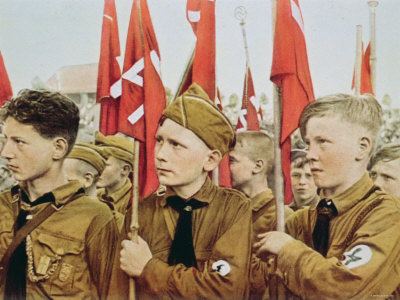
Nazi policies towards youth had two aims:
- Prepare boys and girls for their future roles.
- Indoctrinate them into key Nazi beliefs.
Education
Boys learned Maths, Science and PE to help prepare them to be engineers, scientists or soldiers.
Girls studied Biology and PE to help them to be healthy mothers.
All children studied eugenics (race studies) to learn Nazi prejudices about Jews and the Aryan Race.
Hitler Youth
Boys were expected to join the Hitler Youth and this became compulsory in 1936. They went on camps and marches and learned survival skills and boxing.
Girls had to join the BDM (League of German Maidens) where they studied home making and also took part in sports to make them strong and healthy.
Nazi policies towards youth had two aims:
- Prepare boys and girls for their future roles.
- Indoctrinate them into key Nazi beliefs.
Education
Boys learned Maths, Science and PE to help prepare them to be engineers, scientists or soldiers.
Girls studied Biology and PE to help them to be healthy mothers.
All children studied eugenics (race studies) to learn Nazi prejudices about Jews and the Aryan Race. Nazi ideology was promoted throughout the curriculum, for example in Maths lessons, and teachers would often humiliate Jewish students.
Hitler Youth
Boys were expected to join the Hitler Youth and this became compulsory in 1936. They went on camps and marches and learned survival skills and boxing. Millions took part and many appeared genuinely to enjoy the uniforms and activities although a minority (1 in 10) refused to join.
Girls had to join the BDM (League of German Maidens) where they studied home making and also took part in sports to make them strong and healthy.
Both groups were used to promote Nazi beliefs through songs and learning history.
Nazi policies towards youth had two aims:
- Prepare boys and girls for their future roles.
- Indoctrinate them into key Nazi beliefs.
Education
Boys learned Maths, Science and PE to help prepare them to be engineers, scientists or soldiers.
Girls studied Biology and PE to help them to be healthy mothers.
All children studied eugenics (race studies) to learn Nazi prejudices about Jews and the Aryan Race. Nazi ideology was promoted throughout the curriculum, for example in Maths lessons, and teachers would often humiliate Jewish students.
Hitler Youth (Hitler Jugend - HJ)
Boys were expected to join the Hitler Youth at 10 and then join the main movement at 13. Membership became compulsory in 1936. They went on camps and marches and learned survival skills and boxing. There were 9 million members by 1939 and many appeared genuinely to enjoy the uniforms and activities although a minority (1 in 10) refused to join. During the war they helped the fire service and by the end of the war young boys helped with the defence of Berlin.
Girls had to join the BDM (League of German Maidens) where they studied home making and also took part in sports to make them strong and healthy. Membership was also compulsory from 1936.
Both groups were used to promote Nazi beliefs through songs and learning history.