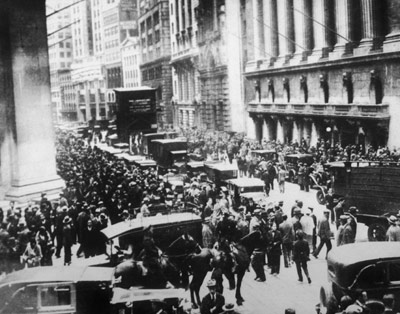
In 1929 the value of shares on the American Stock Market (Wall Street) crashed. This meant that US banks demanded back the loans given to Germany under the Dawes Plan. This had a devastating effect on the German economy which became known as the Great Depression.
Economic Impact
Businesses and shops closed and huge numbers lost their jobs. There were 6m unemployed by 1932.
Political Impact
The Weimar Government became increasingly unpopular because of the Great Depression.
- They raised taxes and cut benefits.
- They also struggled to make decisions because the different parties shared power and couldn’t agree.
Many people started to vote for extremist parties who wanted to end democracy, such as the Nazis (right wing) and the KPD or Communists (left wing).
In 1929 the value of shares on the American Stock Market (Wall Street) crashed. This meant that US banks demanded back the loans given to Germany under the Dawes Plan. This had a devastating effect on the German economy which became known as the Great Depression.
Economic Impact
As the US withdrew its loans, businesses and shops closed and huge numbers lost their jobs. Therefore there were fewer people able to spend money which hurt businesses further. The Depression was worldwide so Germany couldn't sell as many goods abroad. There were 6m unemployed by 1932 and half of young people could not find work. The government kept food prices high to protect farmers. Many people ended up living on the streets and had to resort to soup kitchens as they couldn't afford to eat.
Political Impact
The Weimar Government became increasingly unpopular because of the Great Depression.
- They raised taxes and cut benefits: 15% of the unemployed received no benefits at all.
- They struggled to make decisions because the different parties shared power and couldn’t agree.
Many people started to lose faith in moderate politicians and voted for extremist parties who wanted to end democracy, such as the Nazis (right wing) and the KPD or Communists (left wing). In 1928 the Nazis achieved only 3% of the vote. By 1932 this rose to 37%.
In 1929 the value of shares on the American Stock Market (Wall Street) crashed. This meant that US banks demanded back the loans given to Germany under the Dawes Plan. This had a devastating effect on the German economy which became known as the Great Depression.
Economic Impact
As the US withdrew its loans, businesses and shops closed and huge numbers lost their jobs. Therefore there were fewer people able to spend money which hurt businesses further. The Depression was worldwide so Germany couldn't sell as many goods abroad. German production halved in three years. There were 6m unemployed by 1932 and half of young people could not find work. The government kept food prices high to protect farmers. 17 million people relied upon dole money. Many people ended up living on the streets and had to resort to soup kitchens as they couldn't afford to eat.
Political Impact
The Weimar Government became increasingly unpopular because of the Great Depression.
- They raised taxes and cut benefits: 15% of the unemployed received no benefits at all.
- They struggled to make decisions because the different parties shared power and couldn’t agree.
Many people started to lose faith in moderate politicians and voted for extremist parties who wanted to end democracy, such as the Nazis (right wing) and the KPD or Communists (left wing). In 1928 the Nazis achieved only 3% of the vote. By 1932 this rose to 37%.