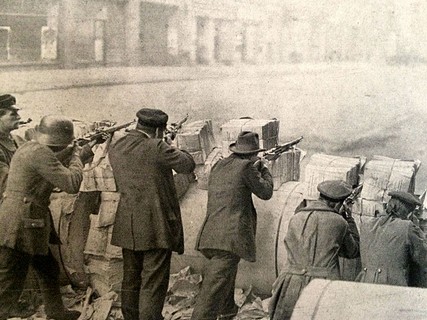
There were many extremist groups that disliked democracy and tried to overthrow the government by force.
Spartacist Uprising, 1919
The Spartacists were German communists. They tried to overthrow the government in January 1919. The government called in the Freikorps to help. The Freikorps were volunteer soldiers who had fought in World War I but were no longer needed in the army. They killed over 3000 communists.
Kapp Putsch, 1920
Wolfgang Kapp disliked the Weimar Republic and wanted to bring back the Kaiser. When the President, Ebert, tried to disband the Freikorps, Kapp led a group of Freikorps to take over the government. They successfully captured Berlin. The army refused to help the government but Ebert ordered the workers to go on a general strike. Kapp realised he couldn't control the country and fled so the uprising failed.
Munich Putsch, 1923
Hitler and the Nazi party tried to take over Germany by force in November 1923. He first took over a Beer Hall in Munich and captured the local government leader (Kahr) and planned to march on Munich. He thought that Kahr now supported him but Kahr escaped and alerted the police. The police and army defeated the Nazis. 16 SA men were killed. Hitler was arrested and sentenced to 5 years in prison but only served 9 months.
There were many extremist groups that disliked democracy and tried to overthrow the government by force.
Spartacist Uprising, 1919
The Spartacists were German communists (the KPD). They tried to overthrow the government in January 1919. Ebert called in the Freikorps to help. The Freikorps were volunteer soldiers who had fought in World War I but were no longer needed in the army. They killed over 3000 communists. Although the government survived, this showed their weakness as they had to depend on the Freikorps for help.
Kapp Putsch, 1920
Wolfgang Kapp disliked the Weimar Republic and wanted to bring back the Kaiser. When the President, Ebert, tried to disband the Freikorps,
Kapp led a group of Freikorps to take over the government. They successfully captured Berlin and the government fled to Dresden. The army refused to
help the government but Ebert ordered the workers to go on a general strike. Kapp realised he couldn't control the country and fled so the uprising failed. This showed the support of the people. However, the government wasn't strong enough to punish Kapp or his followers.
Munich Putsch, 1923
Hitler and the Nazi party tried to take over Germany by force in November 1923. He first took over a Beer Hall in Munich and captured the local government leader (Kahr) and planned to march on Munich. He thought that Kahr now supported him but Kahr escaped and alerted the police. The police and army defeated the Nazis. 16 SA men were killed. Hitler was arrested and sentenced to 5 years in prison but only served 9 months. His trial gave him huge publicity outside Bavaria and made him one of the best known right-wing nationalists in Germany.
Assassinations
Between 1918-1923, right-wing extremists murdered 350 Weimar politicians, including Rathenhau the foreign secretary. Many were not punished severely due to the support from the establishment (police and judges).
There were many extremist groups that disliked democracy and tried to overthrow the government by force.
Spartacist Uprising, 1919
The Spartacists were German communists (the KPD). Led by Karl Liebknecht and Rosa Luxemburg, they tried to overthrow the government in January 1919. Ebert called in the Freikorps to help. The Freikorps were volunteer soldiers who had fought in World War I but were no longer needed in the army. They killed over 3000 communists and Liebknecht and Luxemburg were murdered. Although the government survived, this showed their weakness as they had to depend on the Freikorps for help. A long term consequence of the Spartacist Uprising was that the KPD and the SPD hated each other. This meant that they were slow to co-operate against the threat of the Nazis in the early 1930s.
Kapp Putsch, 1920
Wolfgang Kapp disliked the Weimar Republic and wanted to bring back the Kaiser. When the President, Ebert, tried to disband the Freikorps,
Kapp led a group of Freikorps to take over the government. They successfully captured Berlin and the government fled to Dresden. The army refused to
help the government but Ebert ordered the workers to go on a general strike. Kapp realised he couldn't control the country and fled so the uprising failed. This showed the support of the people. However, the government wasn't strong enough to punish Kapp or his followers and this uprising showed that they didn't have the support of the army.
Munich Putsch, 1923
Hitler and the Nazi party tried to take over Germany by force in November 1923. He first took over a Beer Hall in Munich and captured the local government leader (Kahr) and planned to march on Munich. He thought that Kahr now supported him but Kahr escaped and alerted the police. The police and army defeated the Nazis. 16 SA men were killed. Hitler was arrested and sentenced to 5 years in prison but only served 9 months. His trial gave him huge publicity outside Bavaria and made him one of the best known right-wing nationalists in Germany.
Assassinations
Between 1918-1923, right-wing extremists murdered 350 Weimar politicians, including Rathenhau the foreign secretary. Many of the murderers were not punished severely due to the support from the establishment (police and judges).