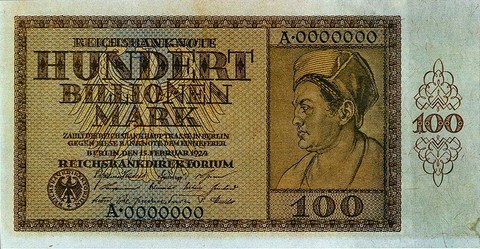
In 1923 the German economy was nearly destroyed by hyperinflation. This means that prices rose incredibly fast - for example a single egg cost 91 million marks.
Causes of hyperinflation
Treaty of Versailles: Germany fell behind with her reparations payments. Therefore France and Belgian troops invaded the Ruhr area and started taking goods instead.
Government actions: the government told workers not to co-operate and go on strike. This was called passive resistance. The government then printed more money to pay the striking workers and to pay the reparation payments. This meant that money lost its value and prices went up. As money lost its value the government printed more and more money which made prices go up even worse.
Consequences of hyperinflation
Economic:
The middle classes lost their savings.
People on fixed incomes - such as pensioners - suffered extreme poverty.
There was no money left in the economy to invest in business.
However, some people benefitted. Those in debt could pay it off for virtually nothing and those with goods to sell, e.g. farmers, could barter and make money.
Political:
Many, especially the middle classes, lost faith in the Weimar Republic and in democracy. Hyperinflation was a long-term cause of the collapse of the Weimar Republic.
A 100 billion mark note. Enough to buy a smalll loaf of bread?
In 1923 the German economy was nearly destroyed by hyperinflation. This means that prices rose incredibly fast - for example a single egg cost 91 million marks.
Causes of hyperinflation
Treaty of Versailles: Germany fell behind with her reparations payments. Therefore France and Belgian troops invaded the Ruhr area and started taking goods instead.
Government actions: the government told workers not to co-operate and go on strike. This was called passive resistance. The government then printed more money to pay the striking workers and to pay the reparation payments. This meant that money lost its value and prices went up so the government printed more and more.
Consequences of hyperinflation
The middle classes lost their savings and lost their trust in the Weimar government.
People on fixed incomes suffered extreme poverty
There was no money left in the economy to invest in business
In 1923 the German economy was nearly destroyed by hyperinflation. This means that prices rose incredibly fast - for example a single egg cost 91 million marks.
Causes of hyperinflation
Treaty of Versailles: Germany fell behind with her reparations payments. Therefore France and Belgian troops invaded the Ruhr area and started taking goods instead.
Government actions: the government told workers not to co-operate and go on strike. This was called passive resistance. The government then printed more money to pay the striking workers and to pay the reparation payments. This meant that money lost its value and prices went up. As money lost its value the government printed more and more money which made prices go up even worse.
Consequences of hyperinflation
Economic:
The middle classes lost their savings.
People on fixed incomes - such as pensioners - suffered extreme poverty.
There was no money left in the economy to invest in business.
However, some people benefitted. Those in debt could pay it off for virtually nothing and those with goods to sell, e.g. farmers, could barter and make money.
Political:
Many, especially the middle classes, lost faith in the Weimar Republic and in democracy. Hyperinflation was a long-term cause of the collapse of the Weimar Republic.
In 1923 the German economy was nearly destroyed by hyperinflation. This means that prices rose incredibly fast - for example a single egg cost 91 million marks.
Causes of hyperinflation
Treaty of Versailles: Germany fell behind with her reparations payments. Therefore France and Belgian troops invaded the Ruhr area and started taking goods instead.
Government actions: the government told workers not to co-operate and go on strike. This was called passive resistance. The government then printed more money to pay the striking workers and to pay the reparation payments. This meant that money lost its value and prices went up. As money lost its value the government printed more and more money which made prices go up even worse.
Consequences of hyperinflation
Economic:
The middle classes lost their savings.
People on fixed incomes - such as pensioners - suffered extreme poverty.
There was no money left in the economy to invest in business.
However, some people benefitted. Those in debt could pay it off for virtually nothing and those with goods to sell, e.g. farmers, could barter and make money.
Political:
Many, especially the middle classes, lost faith in the Weimar Republic and in democracy. Hyperinflation was a long-term cause of the collapse of the Weimar Republic.