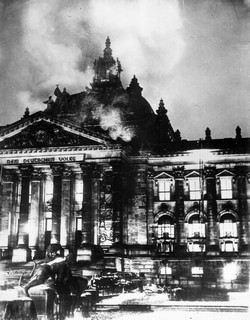
As Chancellor, Hitler's power was severely limited. There were only 3 Nazis in his Cabinet of 11 and the Nazis only controlled 32% of the seats in the Reichstag so could not pass laws unless other parties supported them. Hitler also couldn’t guarantee the support of the President or the army and the trade unions had significant influence. Three key events helped Hitler achieve totalitarian power:
1. The Reichstag Fire, 27 Feb 1933
When the Reichstag burned down, Hitler blamed this on a communist plot which reduced KPD support. He also used the fire to persuade Hindenburg to pass The Reichstag Fire Decree which suspended civil liberties. The Nazis were then able to arrest 4 000 communists (and possibly as many as 10 000 political opponents). Although the KPD were allowed to participate in the March election, winning 81 seats, they were not then allowed to take these seats.
2. The Enabling Act, March 1933
The Nazis won 45% of the vote in the March election, which was well short of the two thirds majority needed to change the constitution. Hitler, however, successfully persuaded the Reichstag to pass an Enabling Law which allowed him to pass laws without their agreement for up to 4 years. He was able to do this because he had already effectively banned the Communist party and he then persuaded the right wing Nationalist party and the Catholic Centre party to support him. Only the SPD voted against the Enabling Act.
Hitler then used the Enabling Act to: ban all other political parties (apart from the Nazis); ban trade unions; take over local government. Germany was now a legal dictatorship.
3. The Night of the Long Knives, June 1934
The main threat remaining to Hitler's power was now from within the Nazi party, and especially from Röhm, the leader of the SA which was 3 million strong by 1934. Hitler and Röhm disagreed about policy (Röhm wanted a Socialist Revolution) and about the role of the SA (Röhm wanted it to take over the Germany army). In June 1934 Hitler used the SS to murder about 1000 opponents, including Röhm and approximately 200 senior Nazis. This removed Hitler's rivals and also gained him the support of the army as they now took over the SA. Now that Hitler had committed mass murder unchallenged, it showed that his power was virtually unassailable.
When President Hindenburg died in August 1934, Hitler combined the role of President and Chancellor into the office of Führer and made all members of the armed forces swear a personal oath of loyalty to him.
The Reichstag Fire
As Chancellor, Hitler did not have a great deal of power. He did not have a majority in the Reichstag so could not pass laws unless other parties
supported him. He also couldn’t guarantee the support of the President or the army. Three key events helped him achieve total power:
1. The Reichstag Fire, Feb 1933
When the Reichstag burned down, Hitler blamed this on a communist plot. He was then able to have 4000 communists arrested so they could no longer oppose him.
2. The Enabling Act, March 1933
Hitler then persuaded the Reichstag to pass an Enabling Law which allowed him to pass laws without their agreement. He was able to do this because he had already arrested Communist deputies and persuaded most parties to support him.
Hitler then used the Enabling Act to ban all other political parties (apart from the Nazis); ban trade unions; take over local government. Germany was now a legal dictatorship.
3. The Night of the Long Knives, June 1934
The main threat remaining to Hitler's power was now from within the Nazi party, and especially from Röhm, the leader of the SA. In June 1934 Hitler used the SS to murder about 1000 opponents, including Röhm and approximately 200 senior Nazis. This removed Hitler's rivals and also gained him the support of the army as they now took over the SA.
As Chancellor, Hitler did not have a great deal of power. There were only 3 Nazis in his Cabinet of 11 and and he did not have a majority in the Reichstag so could not pass laws unless other parties supported him. He also couldn’t guarantee the support of the President or the army. Three key events helped Hitler achieve totalitarian power:
1. The Reichstag Fire, 27 Feb 1933
When the Reichstag burned down, Hitler blamed this on a communist plot which reduced KPD popular support. He also used the fire to persuade Hindenburg to pass an Emergency Decree which the Nazis then used to have 4 000 communists arrested so they could no longer oppose him.
2. The Enabling Act, March 1933
Hitler persuaded the Reichstag to pass an Enabling Law which allowed him to pass laws without their agreement for up to 4 years. He was able to do this because he had already effectively banned the Communist party and he persuaded the right wing Nationalist party and the Catholic Centre party to support him
Hitler then used the Enabling Act to ban all other political parties (apart from the Nazis); ban trade unions; take over local government. Germany was now a legal dictatorship.
3. The Night of the Long Knives, June 1934
The main threat remaining to Hitler's power was now from within the Nazi party, and especially from Röhm, the leader of the SA. Hitler and Röhm disagreed about policies and about the role of the SA. In June 1934 Hitler used the SS to murder about 1000 opponents, including Röhm and approximately 200 senior Nazis. This removed Hitler's rivals and also gained him the support of the army as they now took over the SA. Now that Hitler had committed mass murder unchallenged, it showed that his power was virtually unassailable.
When President Hindenburg died in August 1934, Hitler combined the role of President and Chancellor into the office of Führer and made all members of the armed forces swear a personal oath of loyalty to him.
As Chancellor, Hitler's power was severely limited. There were only 3 Nazis in his Cabinet of 11 and the Nazis only controlled 32% of the seats in the Reichstag so could not pass laws unless other parties supported them. Hitler also couldn’t guarantee the support of the President or the army and the trade unions had significant influence. Three key events helped Hitler achieve totalitarian power:
1. The Reichstag Fire, 27 Feb 1933
When the Reichstag burned down, Hitler blamed this on a communist plot which reduced KPD support. He also used the fire to persuade Hindenburg to pass The Reichstag Fire Decree which suspended civil liberties. The Nazis were then able to arrest 4 000 communists (and possibly as many as 10 000 political opponents). Although the KPD were allowed to participate in the March election, winning 81 seats, they were not then allowed to take these seats.
2. The Enabling Act, March 1933
The Nazis won 45% of the vote in the March election, which was well short of the two thirds majority needed to change the constitution. Hitler, however, successfully persuaded the Reichstag to pass an Enabling Law which allowed him to pass laws without their agreement for up to 4 years. He was able to do this because he had already effectively banned the Communist party and he then persuaded the right wing Nationalist party and the Catholic Centre party to support him. Only the SPD voted against the Enabling Act.
Hitler then used the Enabling Act to: ban all other political parties (apart from the Nazis); ban trade unions; take over local government. Germany was now a legal dictatorship.
3. The Night of the Long Knives, June 1934
The main threat remaining to Hitler's power was now from within the Nazi party, and especially from Röhm, the leader of the SA which was 3 million strong by 1934. Hitler and Röhm disagreed about policy (Röhm wanted a Socialist Revolution) and about the role of the SA (Röhm wanted it to take over the Germany army). In June 1934 Hitler used the SS to murder about 1000 opponents, including Röhm and approximately 200 senior Nazis. This removed Hitler's rivals and also gained him the support of the army as they now took over the SA. Now that Hitler had committed mass murder unchallenged, it showed that his power was virtually unassailable.
When President Hindenburg died in August 1934, Hitler combined the role of President and Chancellor into the office of Führer and made all members of the armed forces swear a personal oath of loyalty to him.