

1933-1945 |
Germany under the Kaiser |
The Weimar Republic |
Nazi Rise to Power |
Life under the Nazis |
The Nazis and the Church
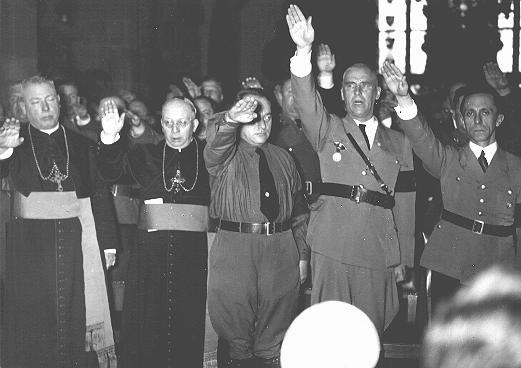
About two thirds of Germans were Protestant and one third Catholic. Hitler was worried about the power of the German Churches so he was keen to control them.
Catholic Church
The Nazis signed an agreement (the Concordat) in July 1933 that gave the Catholic Church its freedom in exchange for not interfering in politics. They mostly did stay out of politics but the Nazis started to make life difficult for the Catholic Church. Children were forced to leave Catholic youth groups to join the Hitler Youth and Catholic schools were closed down. In 1937 Pope Pius XI issued a statement With Burning Anxiety which criticised the Nazis' treatment of the Catholic Church. Cardinal Galen later attacked the Nazi policy of "euthanasia" and succeeded in this being stopped, if only temporarily. Other priests, such as Josef Fath, oposed the Nazis and had strong local support but never threatened the government nationally.
The Nazis took over the Protestant Church and called it the Reich Church led by Bishop Müller. It was loyal to the Nazis. Pastor Martin Niemöller publically preached against the Nazis and he set up an illegal Confessional Church with Dietrich Bonhöffer. Niemöller was sent to a concentration camp but survived the war.
Faith Movement
The Nazis attempted to set up a new, non-Christian religion, based on paganism and a love of nature. However it never really took off (unsurprisingly).
Jehovah's Witnesses
This group strongly resisted the Nazis. The refused to ackowlege the authority of the government above God. Perhaps as many as 30 000 were sent to concentration camps where up to 10 000 died.