1500s & 1600s |
Middle Ages |
Early Modern |
Industrial Revolution |
Scientific Revolution
The Scientific Revolution focused on using reason and experiments to understand the natural world. In the Middle Ages, people felt they could learn all they needed from the Bible. Now, scientists argued that they knew nothing for sure until it had been proved.
Key People of the Scientific Revolution
- Isaac Newton discovered gravity and many of the laws of physics.
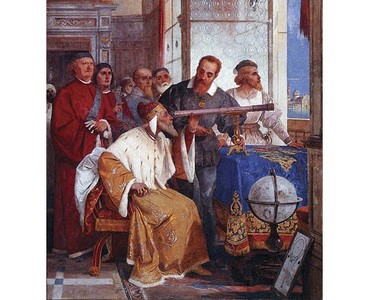
- Galileo proved Copernicus' theory that the Earth goes round the Sun (and not the other way round).
- Andreas Vesalius dissected human bodies to learn about anatomy. He proved that existing ideas about medicine were wrong, leading to a medical renaissance (a period of new ideas).
- Leonardo da Vinci was an artist as well as a scientist. He made an early submarine and also designed a hang-glider and a helicopter.
- Descartes was a philosopher and mathematician famous for his saying I think therefore I am.
Factors that helped the Scientific Revolution
The spread of new ideas was helped by the invention of Guttenberg's printing press in 1450. The weakening power of the Catholic Church following the Protestant Reformation also made it easier for new ideas to flourish.
Significance
The Scientific Revolution reduced the amount of superstition and by the end of the 1600s few people believed in witches.