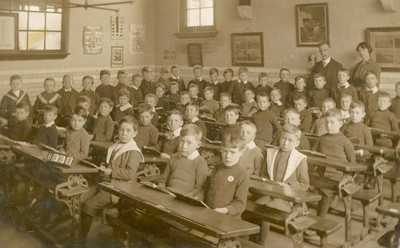
In the early 1800s most children from poor families did not go to school. The wealthy would either go to a public school or be taught by a governess at home.
From 1870 the government started to pass laws to improve education:
- 1870 Education Act: Every local area had to build enough schools for every child (but they still had to pay so not everyone went).
- 1880 Education Act: school was made compulsory for children up to 10 years old.
- 1891 Education Act: primary education became free.
By 1900, most children could read and write, but very few went to secondary school.
In the early 1800s most children from poor families did not go to school. The wealthy would either go to a public school or be taught by a governess at home. During the Victorian era Dame schools became popular with some poorer families until government started to take responsibility for improving education.
- 1870 Forster's Education Act: Every local area had to build enough schools for every child (but they still had to pay so not everyone went).
- 1880 Education Act: school was made compulsory for children up to 10 years old. This was later raised to 12.
- 1891 Education Act: primary education became free.
Classes were large (maybe 70 or 80) and learning focused on the 3 'R's (reading, writing and arithmetic). By 1900, most children could read and write, but very few went to secondary school.
In the early 1800s most children from poor families did not go to school. The wealthy would either go to a public school or be taught by a governess at home. During the Victorian era Dame schools became popular with some poorer families until government started to take responsibility for improving education.
- 1870 Forster's Education Act: Every local area had to build enough school places for every child (but they still had to pay so not everyone went).
- 1880 Education Act: school was made compulsory for children up to 10 years old. This was later raised to 12.
- 1891 Education Act: primary education became free.
Classes were large (maybe 70 or 80) and learning focused on the 3 'R's (reading, writing and arithmetic). Most learning was done by copying. By 1900, most children could read and write, but very few went to secondary school.
Girls' education was developing, with new schools that focused on academic subjects, but these still only benefitted a minority. Schooling for most girls' focused on preparing them to be wives and mothers. This was sometimes called the 3 'S's (sewing, singing and simpering).